Monolithic zirconia vs layered zirconia crowns: A Lab Technician’s Perspective
In the clinic, a crown may look like a simple “tooth cap,” but in the dental lab, there are a lot of choices that affect strength, appearance, and long-term success. The selected materials will determine whether the restoration achieves its intended design or it will require multiple remakes because of color differences and structural failures. Zirconia crowns are one of the current restorative alternatives, which have totally transformed the way dental technicians construct fixed prosthetics. Even in zirconia, there is an ongoing controversy within the laboratories: monolithic or layered? The technician evaluates materials according to their functional role, which drives the entire workflow process that determines the final product’s strength and visual appeal.
Understanding the Core Difference in Zirconia Crowns
It is necessary to know how both methods are constructed within the lab workflow of zirconia crowns before comparing results. This section breaks down the basis of both systems within a real-world lab setting.
1. Monolithic zirconia crowns: single-block precision
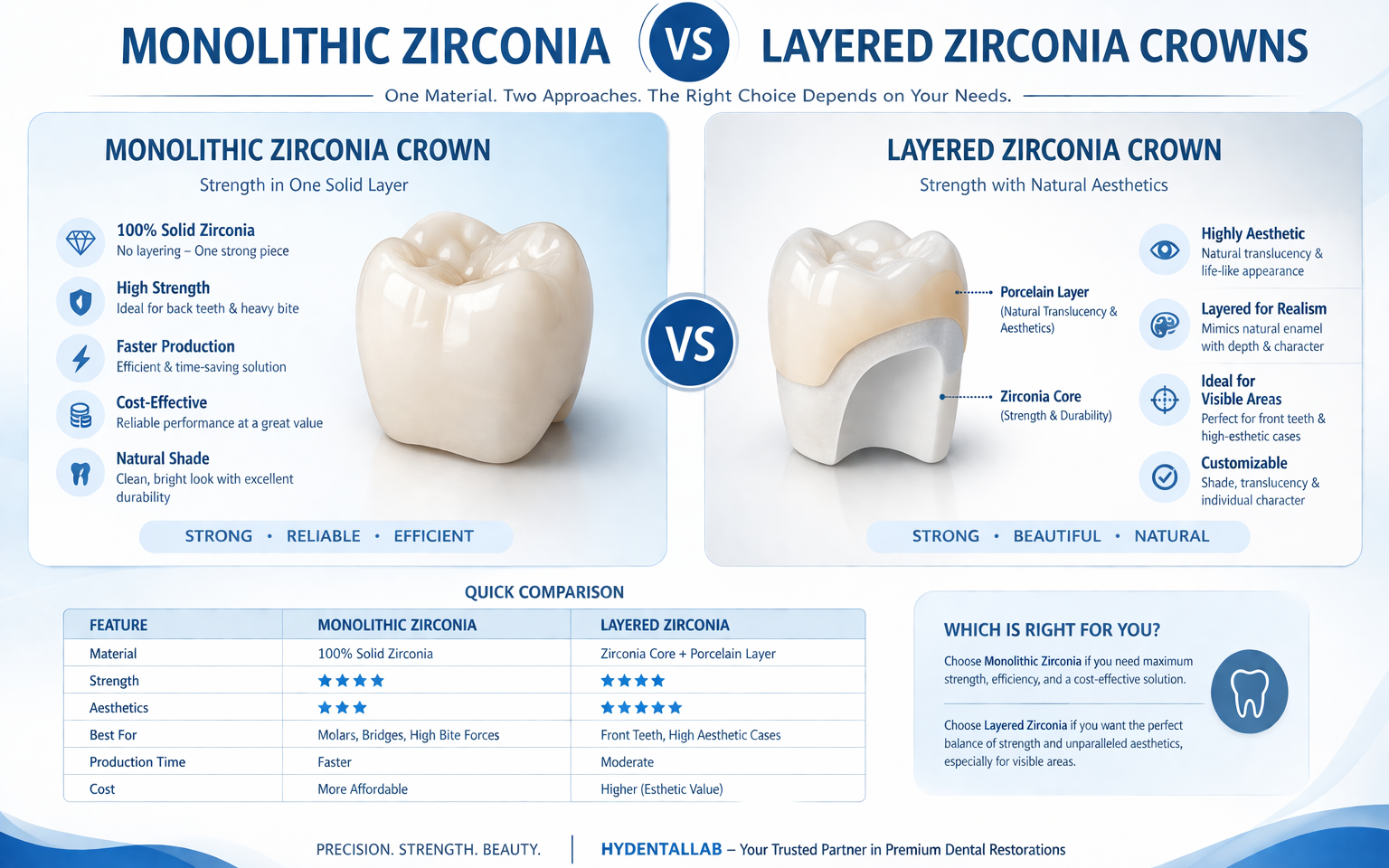
Monolithic restorations are shaped out of a block of zirconia and then stained or glazed to give the final esthetics.
Key lab characteristics include:
- Fully CAD/CAM milled structure
- No veneering porcelain layering
- Low risk of chipping because of strong structure.
- Reduced time in production cycles.
Technicians choose monolithic designs for posterior restorations because these designs show consistent behavior throughout the sintering and finishing processes.
2. Layered zirconia crowns: esthetic craftsmanship approach
Layered zirconia crowns are constructed on a zirconia coping and subsequently porcelain-veneered to provide improved esthetics.
Key lab characteristics include:
- Zirconia base + ceramic coating.
- High esthetic customization
- Enhanced transparency and shade intensity.
- More manual skill involvement.
The process requires technicians to develop their manual abilities through practical work.
Strength vs Esthetics: The Real Trade-off
Technicians experience their highest work pressure at this point because it functions as the main area where all clinical decisions take place during the zirconia crown production process. Instead of considering that it is a competition, laboratories tend to assess both systems according to the case needs.
Strength-focused considerations
Monolithic zirconia maintains its structural strength under extreme occlusal pressure situations.
- Ideal for bruxism cases
- Better fracture resistance
- Reduced risk of long-term maintenance.
- Fits well in molars and full-contour braces.
Esthetic-focused considerations
Layered zirconia is superior in visual realism and the anterior smile areas.
- Higher transparency and light dispersion.
- Self-naturally enamel-like surface depth.
- Customization for shade gradients.
- Ideal in frontal restorations.
Lab Workflow Perspective: What Technicians Actually Experience
The two zirconia crown types produce different effects on laboratory operations, which results in different productivity outcomes.
The actual working environment uses operational reality, which exists beyond the boundaries of scientific material science.
- Monolithic workflow advantages
- Reduced layering time
- Reduced chipping remake rate.
- Streamlined CAD/CAM workflow
- Faster delivery timelines
- Layered workflow challenges
- Higher skill dependency
- Possibility of porcelain delamination.
- Multiple firing cycles
- Increased chairside adjustment requests
The technicians use layered restorations to demonstrate their skilled work, which remains valuable for premium dental restoration work.
Clinical Decision Factors (Lab Collaboration View)
The quality of the alignment of clinicians and technicians in the process of case planning of zirconia crowns is the key to a successful outcome.
Important decision drivers include:
- Pattern of patient occlusion and bite force.
- Esthetic zone involvement
- Shade complexity requirements
- Opposing dentition material
- Budget and turnaround requirements.
When communication is clear, labs can choose the right zirconia system instead of forcing a one-size-fits-all approach.
The Hybrid Reality in Modern Dental Labs
Experienced laboratories have moved beyond their previous selection of one method and now select their method based on the specific needs of each case.
Common real-world usage patterns:
- Monolithic zirconia for posterior strength cases
- Layered zirconia for anterior esthetic cases
- Micro-layering on monolithic base for balanced outcomes
- Customized staining to mimic enamel gradients
The flexible approach has produced better zirconia crown production results because it enables more accurate prediction of outcomes.
Conclusion
At the lab bench, the debate between monolithic and layered zirconia isn’t about which is superior – it’s about which is appropriate for the case in front of you. Monolithic zirconia crowns provide dentists with dependable and robust dental solutions which enhance their work efficiency. Layered zirconia crowns bring artistic design and deep visual appeal, which creates unparalleled beauty.
The ability to apply different techniques at the right moment marks the point where dental laboratories achieve excellence beyond standard manufacturing facilities. HyDentalLab provides precise zirconia solutions, which include both monolithic, durable, and layered aesthetic zirconia options. Let us build restorations that will provide both proper fitting and long-lasting durability.
FAQs
Which is stronger: monolithic or layered zirconia crowns?
Zirconia crowns (monolithic) are mostly stronger as they consist of one solid block without a veneering layer that can be chipped.
Are layered zirconia crowns still used today?
Yes, dentists continue to use layered zirconia crowns for anterior esthetic cases when natural translucency and detailed shading are required.
Are monolithic zirconia crowns natural-looking?
Modern monolithic zirconia crowns have improved esthetics through staining and glazing, but they still lack the depth of layered porcelain.
Why do layered zirconia crowns sometimes fail?
Most failures happen when porcelain materials break off or separate from their base under pressure, especially when dentists fail to control bite force properly.