How to choose the right zirconia shade for anterior restorations
A patient does not necessarily see the margin fit or internal structure of a crown – but they always see the shade. Even a minor mismatch between different elements in the anterior zone leads to immediate restoration failure. The scientific and artistic aspects of zirconia crown creation become essential when patients need more than just strength and durability. Dental professionals and labs now require anterior aesthetics as their standard practice. Achieving realistic zirconia crown results requires more than shade tab testing because it requires knowledge about light behavior, material layers and individual patient characteristics.
Understanding Why Shade Selection is Critical in Anterior Cases
The process of shade selection during restoration procedures determines the overall success and patient satisfaction with treatment. The visual results of anterior restorations show that high-strength zirconia crowns become unappealing when their shade fails to match nearby teeth.
Before we discuss selection methods, we need to clarify why anterior shade matching is a challenge:
- Zirconia materials show different transmission and translucency properties
- Natural teeth are not single-colored.
- The perception of restoration work depends on both gingival tissue and existing dental work
- Risks of digital vs. visual mismatch.
The various factors involved in shade selection for zirconia crowns require multiple decision-making steps instead of straightforward visual estimation.
Key Factors That Influence Shade Selection Accuracy
To achieve predictable results, clinicians and technicians need to evaluate multiple parameters before they select the final zirconia crown shade.
Here’s what truly impacts the outcome:
- Hydra IQ of the teeth: Dehydrated teeth are lighter than normal.
- Lighting conditions: daylight vs. operatory light may change perception.
- Stump shade: Underlying preparation influences end result translucency.
- Adequacy of material translucency level: High translucency vs. multilayer zirconia.
- Age of patient and loss of enamel: Aging teeth need different shade logic.
Lack of attention to such factors can result in remakes of zirconia crowns, which adds to the cost and chair time.
Shade Matching Workflow for Predictable Results
The consistency of working with anterior zirconia crowns can be a beneficial aspect that enhances consistency in anterior zirconia crowns. The professionals now use standard operating procedures instead of making decisions based on their personal judgment.
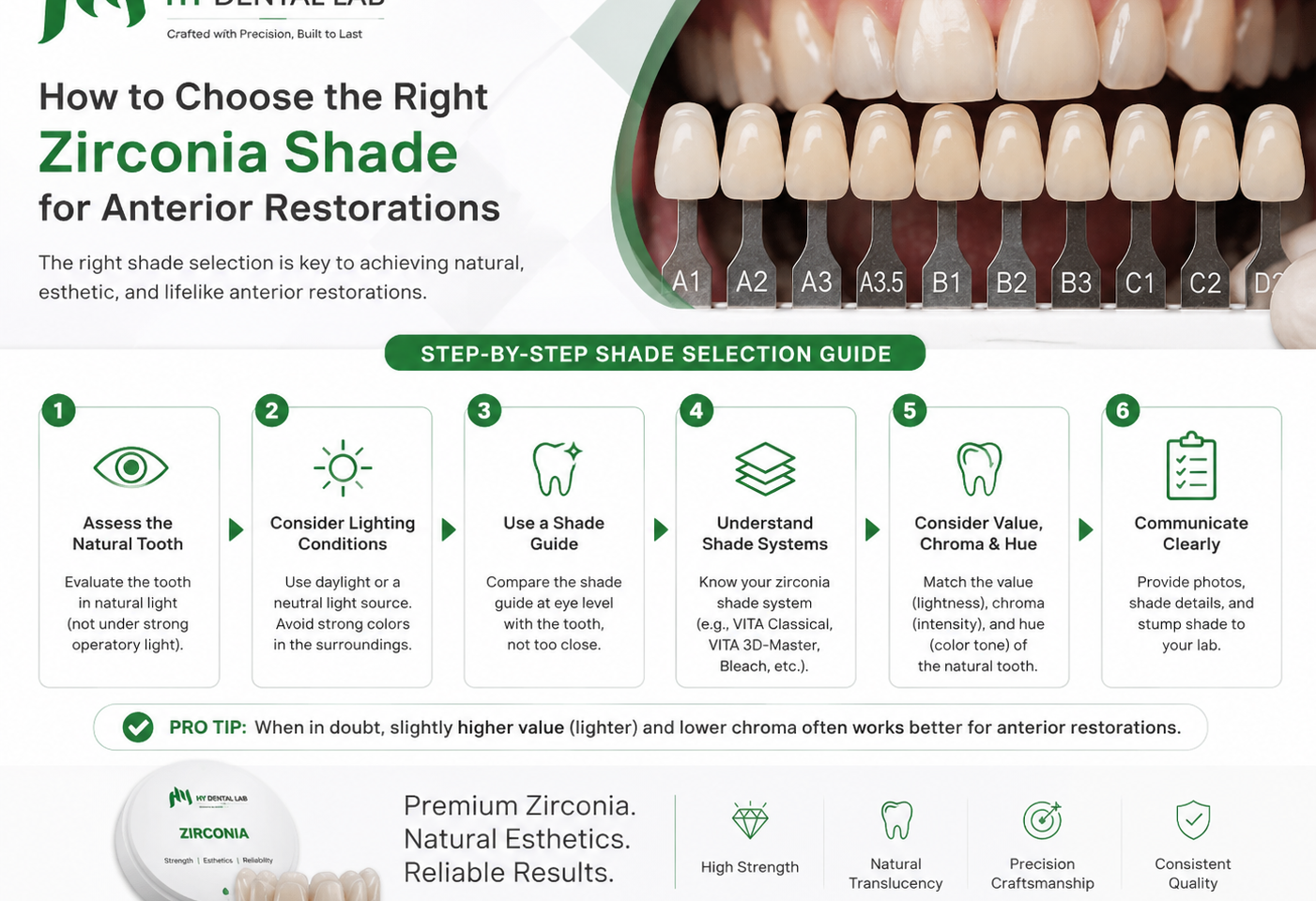
A reliable workflow includes:
- Wipe and rinse teeth prior to shade choice.
- Use multiple shade systems (not just one guide)
- Take pictures under standardized lighting
- Verify with digital shades
- Proper prescription to lab
Clinicians now prefer layering communication methods between chairside assessments and lab confirmations because they believe this approach will help them achieve better zirconia crown results.
Common Mistakes That Lead to Shade Failure
Even professional workers sometimes make errors that affect the ultimate aesthetics of zirconia crowns.
Here are the most common mistakes:
- Selecting shade on dry teeth
- Ignoring adjacent tooth variations
- Over-reliance on digital scans alone
- Not considering translucency gradients
- Poor lab communication regarding shade nuances
These errors can be prevented, which will significantly enhance predictability and minimize reshape failures of zirconia crowns.
Role of Dental Laboratories in Shade Precision
Restorative dentistry requires both clinical work and collaborative effort. Dental labs work together with dentists to create their anterior zirconia crown projects according to their specific shade requirements. This is where expert labs like Hy Dental Laboratory make a difference. Their advanced layering techniques and digital shade-matching system, together with their deep material knowledge, enable clinicians to produce outstanding aesthetic results. Whether it’s multilayer zirconia or customized shading protocols, lab input ensures that zirconia crowns meet both functional and aesthetic expectations.
Conclusion
Selecting an appropriate shade has become essential because it determines the success of restorative work. In anterior dentistry, results are defined by the patients, first visually and secondarily technically. This is why learning how to select the shade of zirconia crowns is crucial to every contemporary clinician and lab. Precision, communication, and material science concurring lead to predictable results when it comes to patient satisfaction. If you want high aesthetic results using zirconia crowns, partner with Hy Dental Laboratory to achieve matchless shade precision, craftsmanship, and consistency.
FAQs
Why is shade matching complicated in anterior restorations?
Anterior teeth are easily visible and sensitive to light, translucency, and other tissues; this complicates an accurate color match in zirconia restorations.
Can digital shade matching replace visual methods?
Digital tools improve accuracy but cannot fully replace clinical judgment. A combination approach is best for zirconia crowns.
What is the best zirconia type for anterior aesthetics?
Multilayer or high-translucency zirconia is often preferred for anterior zirconia crowns due to better light transmission.
How does tooth dehydration affect shade selection?
Dehydration makes teeth appear lighter, which results in incorrect shade selection for zirconia crown restorations.