

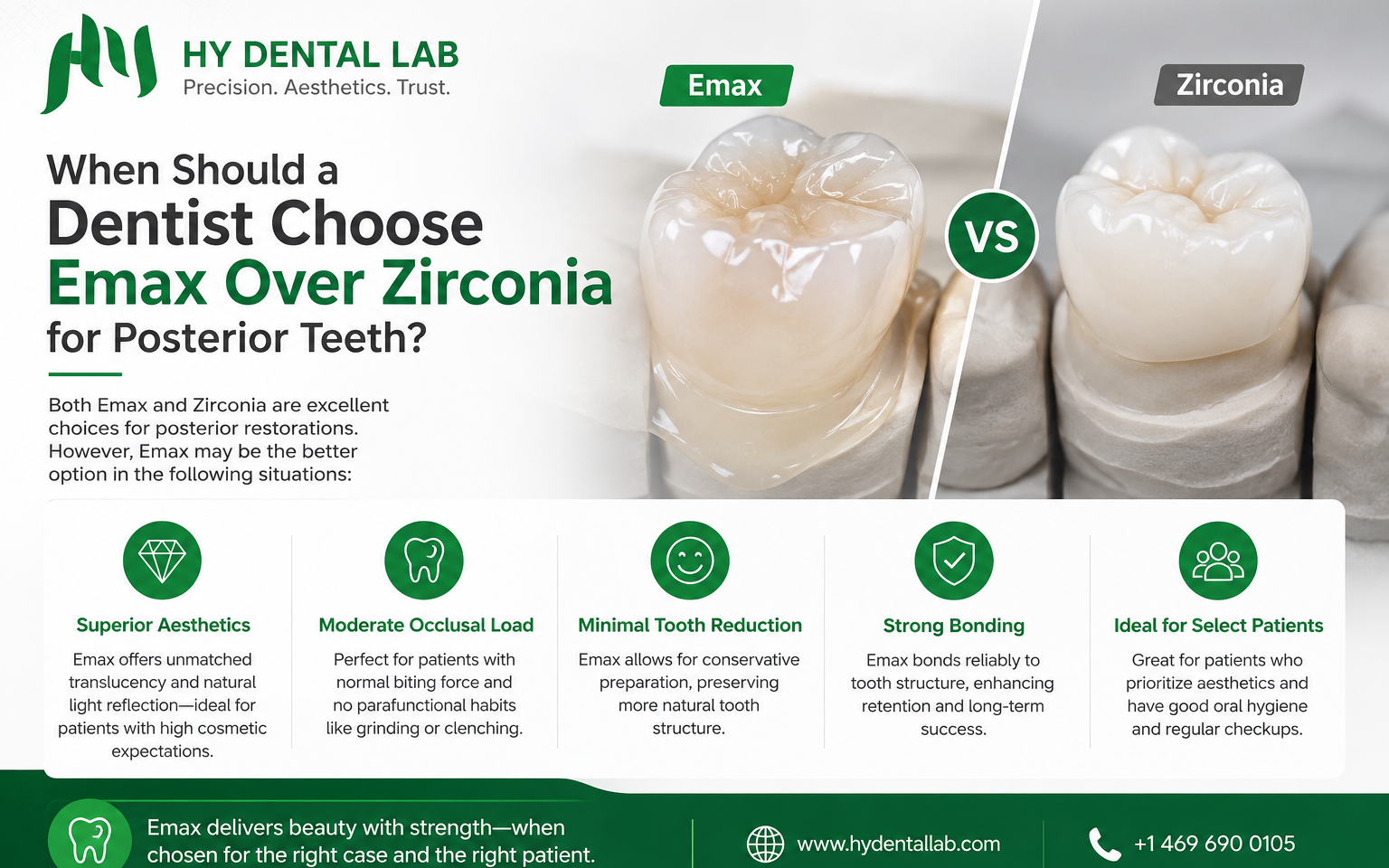
When Should a Dentist Choose Emax Over Zirconia for Posterior Teeth?
Your patient is sitting in the chair. Tooth #30 is gone. They desire something strong, durable, and, hopefully, something that does not scream “dental work.” You pick up the lab slip. Then the question strikes you: Emax or zirconia crowns? A majority of dentists switch to zirconia in posteriors without thinking for a second time. And in the majority of instances that instinct is right. But not always. Certainly, there exist some clinical windows in which Emax is not only acceptable in the case of posterior teeth but is even the wiser option. Knowing the difference is what separates a good restoration from a great one.
This guide breaks it down clearly, so you can make that call confidently every time.
The core difference that changes everything
It is always good to know what distinguishes these two materials at the clinical level, not just on paper but for practical application.
| Emax (Lithium Disilicate) | Zirconia Crowns |
|
|
To summarize: Emax prevails in aesthetics and bond strength. Zirconia crowns are victorious in raw mechanical strength. These two factors come into conflict the most in the posterior zone.
So when does Emax make sense for posterior teeth?
The answer isn’t one-size-fits-all. It comes down to four key clinical conditions – and when these are met together, Emax is not a compromise. It’s a sound choice.
1. The patient has a light-to-moderate bite force
Emax holds up well in the posterior zone – but only when occlusal forces are within a manageable range. For premolars and first molars in patients without parafunctional habits, Emax can perform reliably for 10+ years. Clinical data shows a 94% survival rate for Emax restorations over a decade, which is clinically respectable. However, the moment a patient shows signs of heavy clenching or grinding, Emax becomes a liability in the posterior. That 400 MPa flexural strength, while strong, cannot match the sustained load that zirconia crowns absorb without blinking.
| Clinical rule of thumb: If the patient has wear facets, craze lines, or a history of fractured restorations – do not place E.max posteriorly. Go straight to full-strength zirconia crowns. |
2. Tooth preparation is adequate but conservative
Emax requires good preparation -1.5 mm of occlusal reduction and 1 mm of the axial wall height – but it will then reward your effort with a very bondable surface. Bonding between Emax and tooth structure is included in the strength of the restoration when there is enough left enamel substrate to cement. It is a true clinical benefit that zirconia crowns do not provide in the same manner.On the other hand, zirconia is compatible with traditional cement and requires a minimum of 4 mm of vertical wall height to be held reliably. Where mechanical retention is inadequate, emax adhesive bonding can actually be compensating where the enamel is healthy and abundant, but the preparation is short.
3. Aesthetics matter – even in the posterior
Some dentists are surprised by this one, but it is more than just about that. Premolars, particularly in patients with a broad smile line or high lip line, are very visible. The appearance of a zirconia crown may appear conspicuous to nearby natural teeth. The chameleon effect of Emax, which is a variation of translucency and shade of natural enamel, can be seen to make a tangible impact on patient satisfaction in these situations.
- A large smile showing premolars? Here, Emax is an option to consider.
- Deep posterior molar with no aesthetic concern? Zirconia crowns are the safer call.
- Patient has adjacent natural teeth with strong translucency? Emax blends; zirconia may stand out.
4. The case involves a premolar, not a molar
Location within the posterior zone matters significantly. Premolars experience substantially lower occlusal forces than first and second molars. At Emax’s strength range, premolar restorations are well within safe limits for most patients – provided bruxism is ruled out. First molars sit at the peak of chewing force concentration. Second molars even more so. For these positions, zirconia crowns are the default recommendation for good reason. Emax in a second molar is a case that requires very careful patient selection and a strong bonding protocol – it’s possible, but the margin for error is smaller.
Quick Clinical Decision Table:
| Clinical Factor | Choose Emax | Choose Zirconia Crowns |
| Tooth position | Premolars, first molars (selected cases) | First & second molars (default) |
| Bruxism present | ✕ Avoid Emax | ✓ First choice |
| Aesthetic priority | ✓ Strong advantage | Acceptable with esthetic zirconia |
| Bonding substrate | Enamel-rich, adhesive protocol | Short prep, conventional cement |
| Multi-unit bridge | ✕ Not recommended (spans >2 units) | ✓ Preferred |
| Discolored stump | ✕ May show through | ✓ Better masking |
Where emax consistently falls short in posteriors
To be fair to your patients – and your lab – there are scenarios where Emax should simply not be on the table for posterior work, regardless of how clean the preparation looks.
- Bruxism: Zirconia crowns, which are monolithic full-strength types, such as BruxZir, are designed to do this. The sustained grinding risk of Emax fracture is well documented.
- Long-span bridges: Emax should not be used in traditional three-unit or longer posterior bridges because it lacks the strength of span. Zirconia crowns can easily deal with multi-unit cases at the back.
- Many discolored stumps: the translucency of Emax, which is its best aesthetic strength, becomes a liability when the underlying tooth is dark.
- Restorations in high-stress areas with implants: Zirconia crowns are the clinical standard in this case.
Get restorations that match your clinical decision
HYDentalLab work with dentists who think carefully about material selection – because we do too. Whether your case calls for precision Emax bonding or high-strength zirconia crowns built for demanding posteriors, our lab delivers restorations fabricated to your exact clinical parameters. Stop guessing. Start getting restorations that match how you think. Partner with HY Dental Lab today.
FAQs
Is it possible to use Emax on molars?
Yes – when case selection is strictly done. It is most effective on first molars when the patient has a light bite, is not bruxed, and has good bonding conditions. Zirconia crowns are the less risky option when it comes to second molars.
Is zirconia always better than emax for back teeth?
No. Zirconia crowns are stronger, but emax is good where the stress is low in the back and the esthetics and bonding are important.
Does Emax wear down opposing teeth?
No. Emax is enamel-compatible and wears less than zirconia crowns when well polished.
All the best